

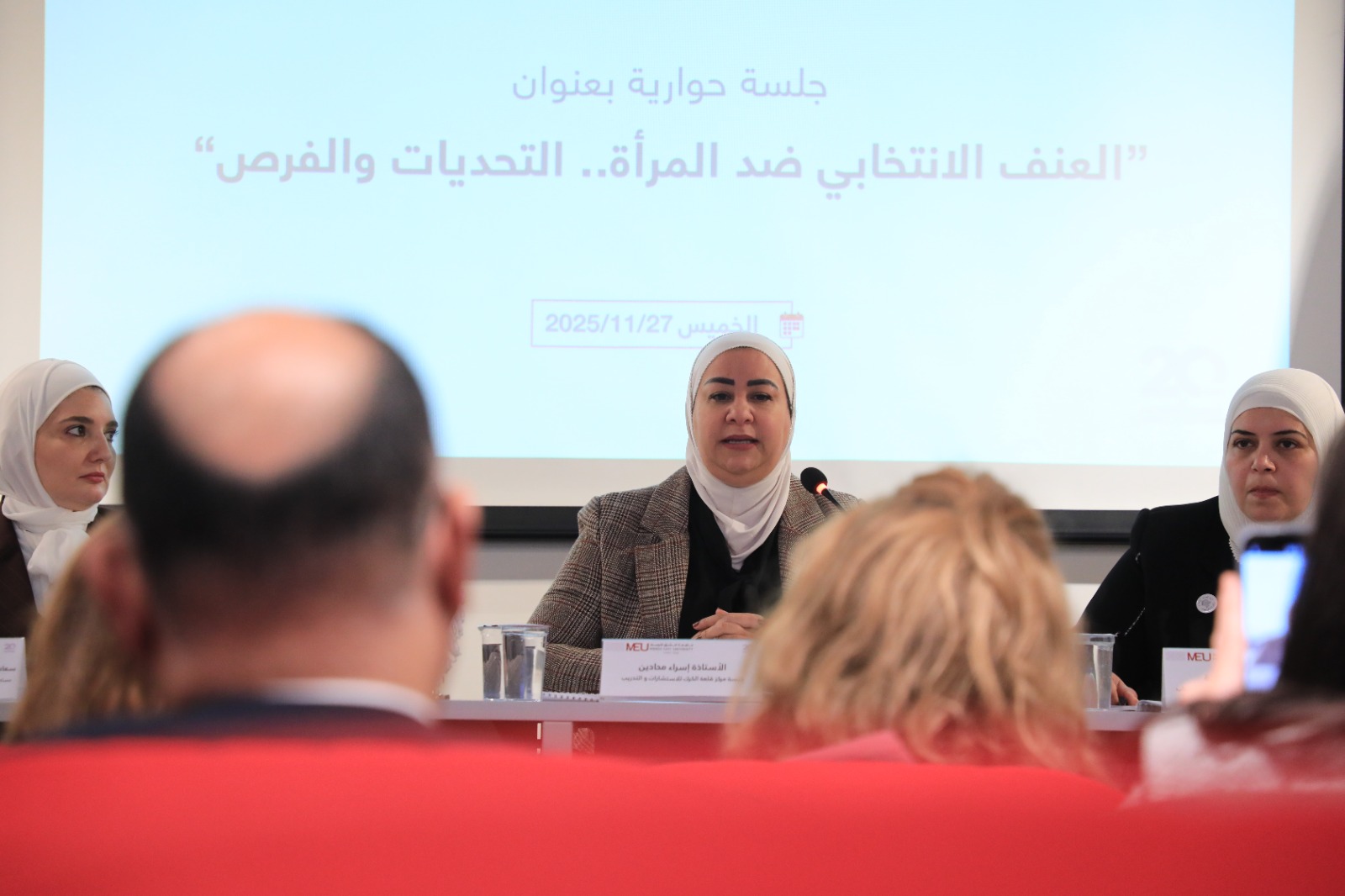
Middle East University organised an extensive dialogue session entitled ‘Electoral Violence Against Women: Challenges and Opportunities’, sponsored by the Secretary General of the Jordanian National Commission for Women, Her Excellency Maha Ali, and attended by MP Prof. Tamara Nasser Eddin, President of the Karak Castle Centre for Consulting and Training, Ms. Israa Mahadin, and Director of the Women’s Empowerment Unit at the Independent Election Commission, Ms. Samar Tarawneh.
The session witnessed the presence of the university president, Professor Salam Mahadin; her vice president, Prof. Ahmad Al-Louzi; deans of faculties; a select group of female leaders; academics; experts in law and political empowerment; and a group of students.
The Secretary General of the Jordanian National Commission for Women, Maha Ali, in her speech during the opening session of the symposium, which was moderated by Dr. Hanan Al-Sheikh, a faculty member at the Faculty of Media, reviewed the role of the National Commission in the political empowerment of women and the promotion of their participation in public life, emphasising its commitment to following up on the implementation of the objectives of the National Strategy for Women 2020 -2025 and its implementation plan, to provide effective mechanisms for the prevention, protection and response to violence against women and girls in the public, private and digital spheres, in cooperation with national authorities, partners and civil society, especially since digital violence is one of the forms of violence to which women active in public life are exposed and which sometimes leads to their withdrawal from the public scene.
With regard to legislation related to electoral violence against women, she explained that Jordan’s legal and procedural framework has developed significantly in recent years and provides reasonable protection in terms of criminalising electoral violence but still needs to develop specific provisions to protect women from electoral violence.
Speaking on behalf of the university, Professor Salam Al-Mahadin stated that Middle East University is committed to supporting women leaders in developing their political and leadership skills through specialised training programmes and research and community initiatives that contribute to enhancing women’s participation in the electoral process.
In her speech, Prof. Tamara Nasereddin presented an in-depth analysis of one of the most prominent challenges facing women in their political careers, namely cyber violence, which began before the launch of her election campaign and continued thereafter, taking various forms from digital bullying to organised attacks aimed at influencing public opinion and undermining women’s presence in the political arena.
She also pointed out that this experience reflects the reality faced by many female candidates, which calls for the development of a more stringent legal protection system and the strengthening of training and digital media programmes to ensure a fair electoral environment that does not exclude or restrict women.
As for the Head of the Karak Castle Centre for Consultancy and Training, Ms. Israa Mahadin, she emphasised that effectively tackling electoral violence requires the development of monitoring protocols based on precise documentation and analysis standards and the provision of integrated support packages that include psychological counselling and legal assistance. In addition, Samar Tarawneh, Director of the Women’s Empowerment Unit at the Independent Election Commission, noted that the commission is working to activate mechanisms to facilitate reporting and protection in cooperation with law enforcement agencies and to expand awareness and training programmes for female candidates and their campaign teams.
As a result, the dialogue session aims to open up new horizons that pave the way for building a safer electoral environment that supports women and empowers them to participate in politics with greater confidence, effectiveness and ability to influence public life.