
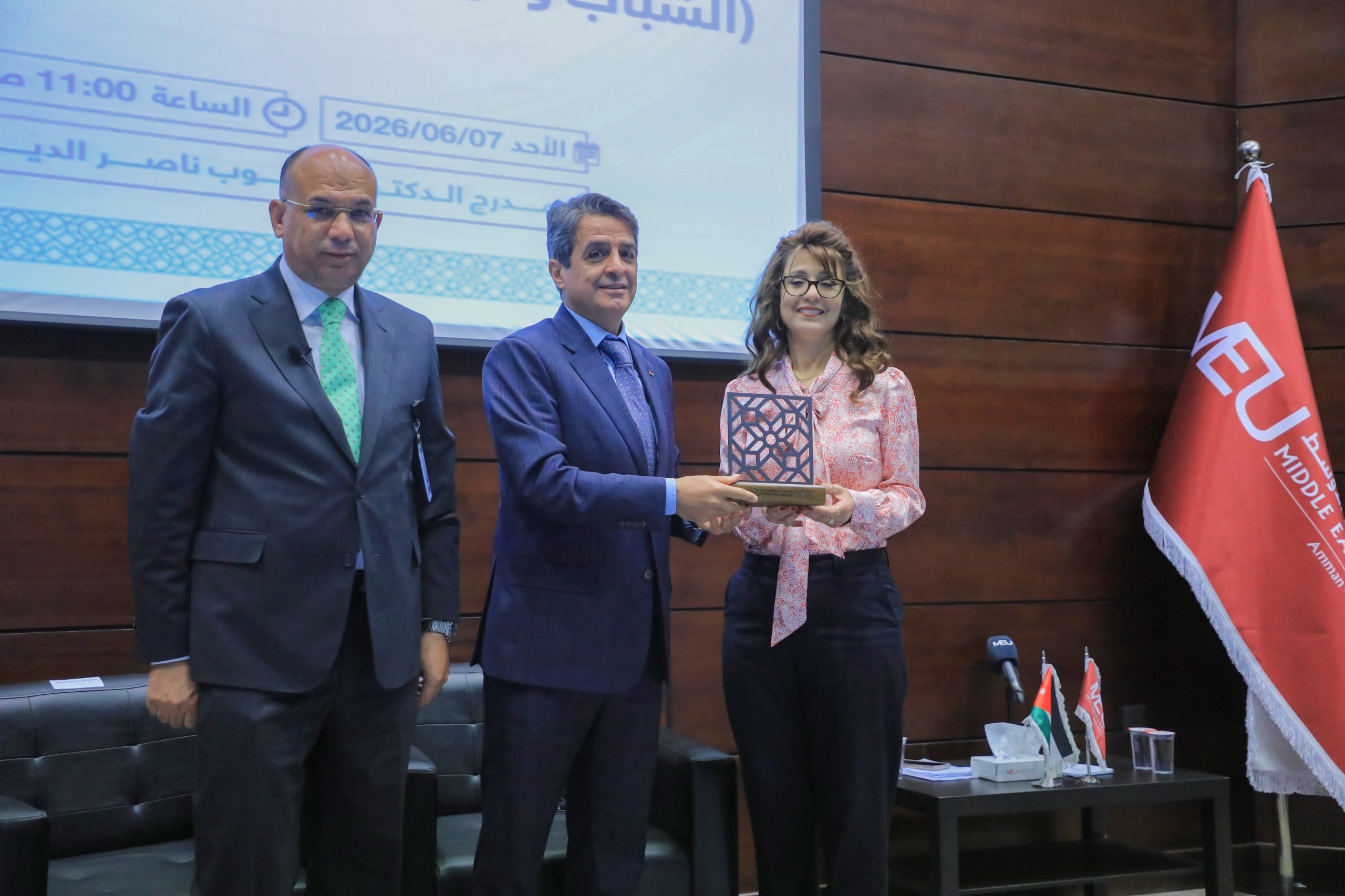
During an extensive panel discussion organised by Middle East University on the role of youth in shaping the future, the minister of youth, Dr. Raed Al-Adwan, stated that young people constitute the cornerstone of the national project. He emphasised that they receive direct attention from His Majesty King Abdullah II, who has made their empowerment and the investment in their potential a national priority. Furthermore, the minister noted that His Royal Highness Prince Al-Hussein bin Abdullah II, the Crown Prince, embodies an inspiring model in supporting youth initiatives and enhancing their presence across various developmental and leadership pathways.
The event took place in the presence of the president of the university, Professor Salam Al-Mahadin; the dean of student affairs, Dr. Hazem Al-Nsoor; alongside various faculty deans, members of the academic and administrative staff, and a large gathering of students.
In his remarks, Al-Adwan pointed out that political modernisation pathways have significantly contributed to expanding horizons for youth participation in public life and decision-making. Consequently, this progress has served to entrench a culture of active citizenship and social responsibility, thereby reinforcing the role of young people as genuine partners in building the future.
Echoing this perspective, the dean of student affairs, Dr. Hazem Al-Nsoor, indicated that authentic investment in the future of nations begins with empowering the youth and providing them with environments that mature their national awareness, cultivate their critical thinking abilities, and foster active engagement in public affairs.
He further explained that Middle East University takes a systematic approach to develop leaders who are aware, can understand changes, recognise challenges, and turn them into opportunities to make a positive impact. To this end, Al-Nsoor added that the university views its students as a renewable national energy and a strategic human capital relied upon to bolster developmental pathways with knowledge, competence, innovation, and the capacity to generate sustainable impact.
The culmination of the session featured a rich, interactive dialogue with the students. This discussion focused on the most prominent issues and challenges associated with university youth activities, alongside opportunities for empowerment, training, and participation in public affairs.