

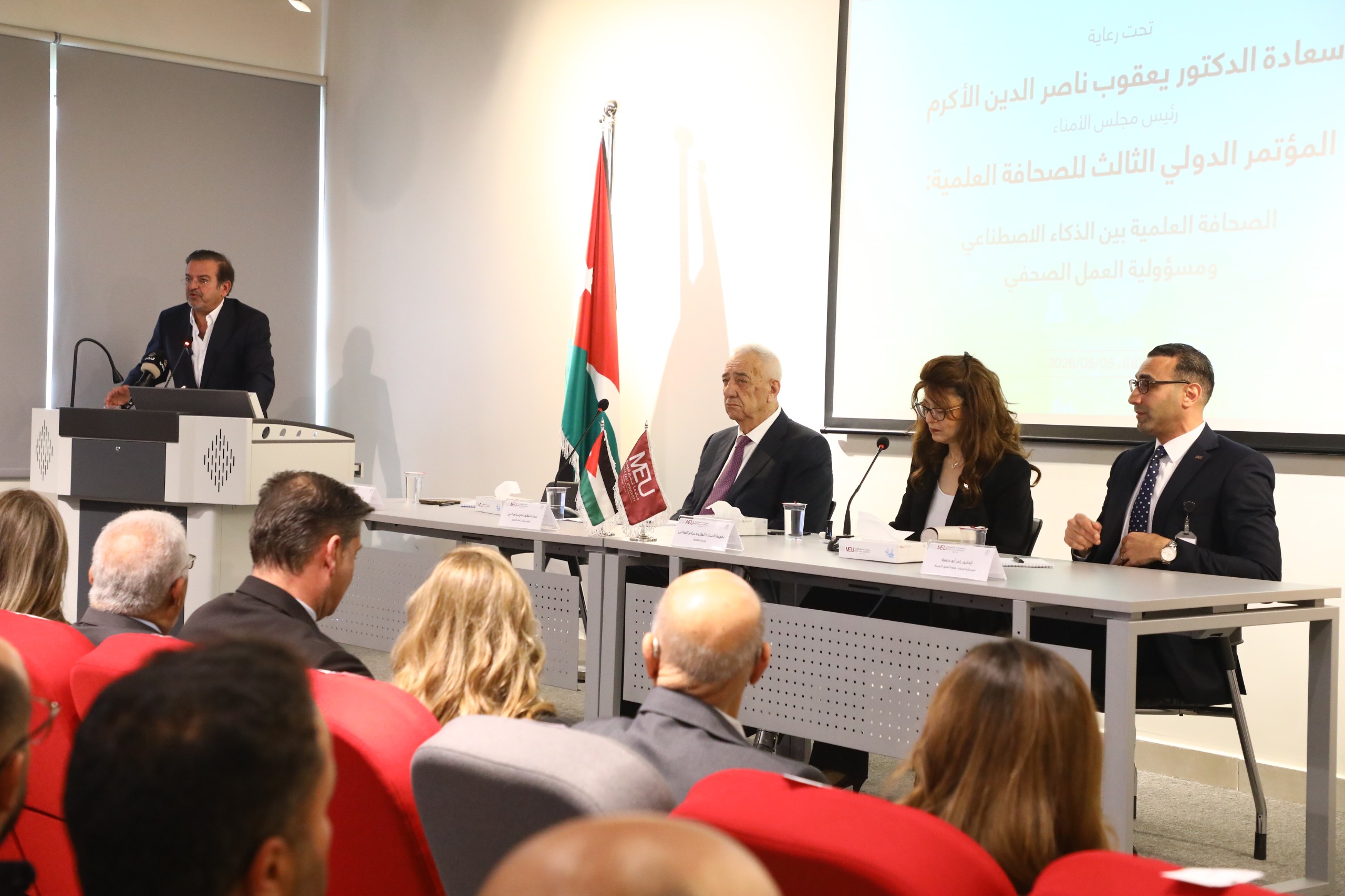
Middle East University inaugurated the Third International Science Journalism Conference, an initiative spearheaded by the Faculty of Media. Held under the patronage of Dr. Yacoub Nasereddin, Chairman of the University’s Board of Trustees, the event brought together a diverse cohort of researchers, academics, and media professionals from ten Arab nations. Representing various prestigious universities and news organisations, these participants convened with the primary objective of redefining the role of science journalism amidst a landscape of rapid digital transformation.
In his opening remarks, Dr. Nasereddin—accompanied by the President of the University, Professor Salam Al-Mahadin—emphasised that the media remains a fundamental pillar of society, serving as a “fourth estate” and a multi-dimensional national catalyst. Regarding the advent of artificial intelligence (AI), he asserted that while it represents a sophisticated tool capable of enhancing operational efficiency within the media sector, it must not be viewed as a substitute for human cognition or the rigour of critical methodology.
Building upon this perspective, Professor Al-Mahadin underscored the vital necessity of science journalism in demystifying complex knowledge and rendering it accessible to the general public. She noted that the conference addresses fundamental questions regarding the nature of “truth” in the burgeoning era of AI. In a similar vein, Dr. Ramez Abu Hasira, Dean of the Faculty of Media, observed that the conference’s timing—coinciding with World Press Freedom Day—reflects the intrinsic link between freedom of expression and professional accountability. He further explained that the event is part of a broader academic trajectory aimed at bolstering scientific research and fostering specialised discourse on the future of the discipline.
Furthermore, the conference explored several strategic themes through its dialogue and scientific sessions. Central to these discussions was the role of AI in simplifying scientific knowledge for public consumption, balanced against the persistent challenges of scientific accuracy and content integrity. Linked to these technical concerns were the ethical dilemmas posed by an increasing reliance on algorithms, specifically addressing issues of bias, intellectual property, and transparency in the deployment of smart tools.
Finally, the proceedings examined the evolution of the scientific newsroom, investigating mechanisms for integrating AI into data collection and reporting while resolutely safeguarding the essential human editorial role.