

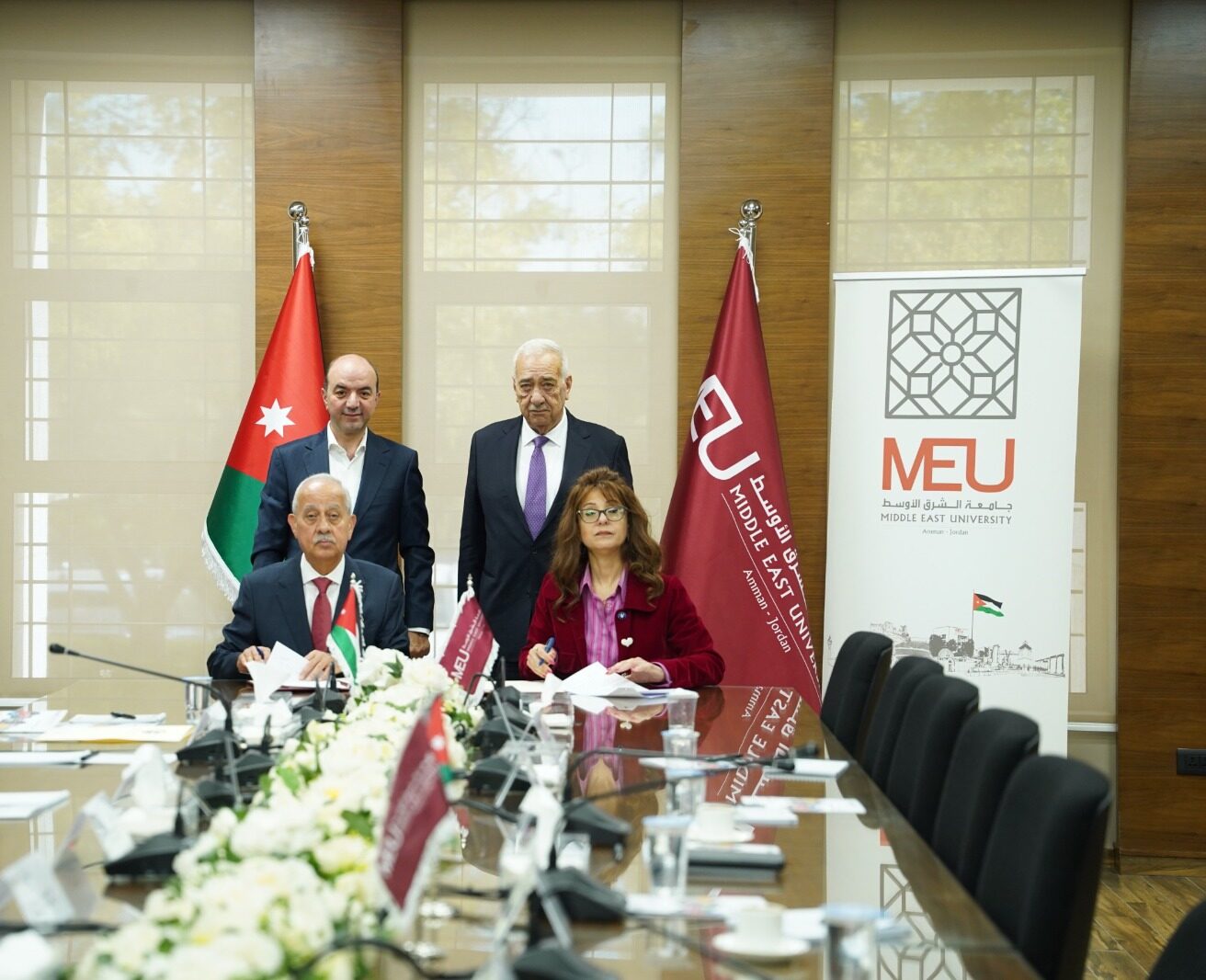
The Chairman of the Board of Trustees of Middle East University (MEU), Dr. Yacoub Nasereddin, met with the Chairman of the Jordan and Amman Chambers of Industry, Eng. Fathi Jaghbir, and his accompanying delegation, in the presence of MEU President, Professor Salam Mahadin, to explore opportunities for establishing an applied partnership aimed at harnessing scientific research to address challenges facing the industrial sector.
The discussions focused on aligning academic outcomes with national priorities, industrial requirements, and evolving labour market demands, thereby contributing to the development of qualified human capital, fostering innovation, and advancing sustainable economic development.
In this context, Jaghbir reaffirmed the readiness of both Chambers of Industry to pursue a practical model of cooperation with the University. He underscored the importance of providing students with opportunities for direct engagement in professional environments and exposure to the expertise of business leaders and industrial practitioners. Such engagement, he noted, would enhance students’ professional preparedness and deepen their understanding of the industrial sector’s operational requirements and essential competencies.
Jaghbir further emphasised the importance of strengthening mutual trust and institutional collaboration between industry and academia, noting that Jordan’s industrial sector has demonstrated considerable resilience in responding to crises and continuously enhancing its productive capabilities.
He added that the Jordan and Amman Chambers of Industry are working to align educational outcomes with the actual needs of industry through specialised vocational training programmes and initiatives connecting graduates with industrial enterprises. These efforts, he explained, seek to bridge the gap between academic qualifications and the practical competencies required in contemporary industrial environments.
For his part, Dr. Nasereddin stressed that the accelerating transformations shaping the global landscape necessitate greater coordination and integration among national educational institutions and relevant stakeholders. He highlighted the importance of developing a results-oriented partnership that serves national interests by translating academic research and postgraduate theses into purposeful, implementable projects undertaken in coordination with the relevant industrial entities.
He reaffirmed the University’s commitment to advancing this collaborative approach and translating the Memorandum of Understanding into concrete operational initiatives with measurable outcomes.
Addressing the importance of strategic foresight, Dr. Nasereddin announced the University’s decision to establish a dedicated Futures Foresight Unit. The Unit is intended to strengthen evidence-based strategic planning and provide a collaborative platform through which the industrial sector can actively participate in anticipating emerging challenges, identifying future opportunities, and informing long-term development priorities.
MEU President, Professor Salam Mahadin, stated that the meeting represented an important step towards expanding institutional cooperation and directing scientific research towards the practical needs of the industrial sector.
She emphasised the importance of reinforcing confidence in the capacity of students and academic staff to develop innovative, research-driven solutions to the challenges confronting industry.
Professor Mahadin further noted that the University offers approximately 40 academic programmes, whose collective knowledge, disciplinary expertise, and research capabilities can be mobilised to address industrial challenges through high-impact applied research projects aligned with labour market requirements.
She also highlighted the growing importance of competency-based approaches to employability, observing that contemporary labour markets increasingly prioritise demonstrable skills and practical capabilities over academic credentials alone.
Meanwhile, the Director of the University’s Innovation and Career Development Centre, Professor Anis Al-Mansour, explained that the Centre plays a central role in empowering students and connecting their academic projects with real-world societal needs and development priorities.
He also outlined ongoing efforts to strengthen business incubation initiatives and preparations for the launch of an innovation platform designed to support entrepreneurial activity and the practical application of innovative ideas.
These initiatives form part of a broader institutional endeavour to establish a sustainable university–industry collaboration model in which Middle East University serves as an active partner in advancing Jordan’s industrial sector.
Through targeted scientific research, practice-oriented student development, and partnerships grounded in clearly identified industrial challenges and strategic priorities, the University seeks to enhance the competitiveness of Jordanian products while ensuring that investments in knowledge generate tangible economic and societal value.
The event also featured the inauguration of specialised professional diploma programmes designed to equip students with labour market-relevant skills and competencies, with the participation of more than 300 students.
The visiting delegation subsequently toured the University’s campus and facilities, gaining firsthand insight into its academic environment, infrastructure, and institutional capabilities.