

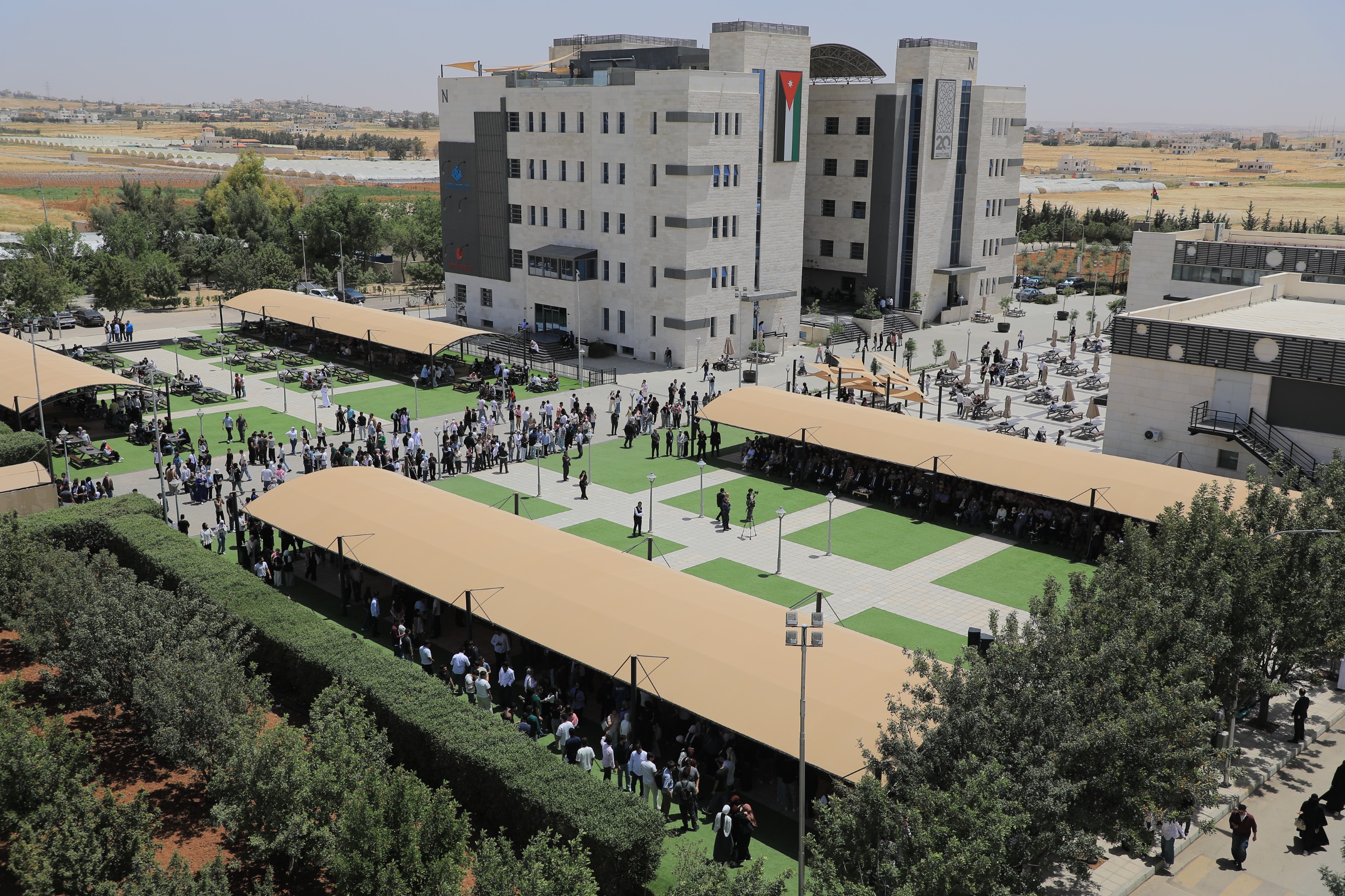
Middle East University grandly celebrated the milestone 80th Independence Day of the Hashemite Kingdom of Jordan, orchestrating a profound national event charged with political and cultural proclamations. The commemoration resolutely affirmed Jordan’s pre-eminent standing as an exemplar of geopolitical stability, resilience, and moderation within a volatile regional landscape defined by rapid transformations and complex structural challenges. The distinguished ceremony operated under the esteemed patronage of the Chairman of the Board of Trustees, Dr. Yacoub Nasereddin, alongside the President of the University, Professor Salam Al-Mahadin, drawing a notable convergence of diplomatic dignitaries, parliamentary leaders, security chiefs, senior academics, and an expansive representation of international Arab students.
Serving as a primary testament to the event’s historical weight, Senate Member His Excellency Senator Hussein Al-Hawatmeh delivered a powerful address, defining the Kingdom’s Independence Day as a pivotal national juncture in the architecture of the modern Jordanian state. He underscored its deep symbolic ties to human capital development, institutional consolidation, and the fortification of national identity. Furthermore, Senator Al-Hawatmeh highly commended the instrumental role higher education institutions play in embedding the core values of national belonging within the youth, effectively anchoring them to the state’s monumental historical milestones.
Expounding upon this historical trajectory, he noted that Jordan enters its second centennial amidst a global and regional climate fraught with systemic shifts—a reality demanding a more profound reading of independence, not as a static historical event but as a continuous, dynamic project aimed at engineering a robust institutional state capable of navigating external volatility while safeguarding its sovereign constants. He further evaluated how Jordan, since its foundational inception, has systematically confronted intricate challenges imposed by challenging geography, resource scarcity, and chronic regional upheavals. Yet, through the strategic wisdom of the Hashemite leadership and the unyielding social cohesion of its citizenry, the kingdom has consistently converted these existential challenges into fertile opportunities for socio-economic advancement, emerging as a definitive regional benchmark for security and institutional moderation.
This macro-level narrative of state resilience was explicitly reinforced by Dr. Yacoub Nasereddin during his keynote address, masterfully moderated by the veteran media figure, Prof. Hani Al-Badri. Dr. Nasereddin affirmed that Jordan’s Independence Day embodies an uninterrupted civilisational journey predicated on embedding national, pan-Arab, and humanitarian ideals. These efforts have successfully actualised the parameters of the modern state envisioned by the Hashemite monarchy since the establishment of the emirate, advancing progressively today under the visionary leadership of His Majesty King Abdullah II bin Al-Hussein.
Crucially, he sharply noted that contemporary civic consciousness serves as one of the most vital defensive pillars underwriting national security. Dr. Nasereddin reiterated that through the absolute resolve of its leadership and the collective willpower of its people, Jordan remains intrinsically equipped to transcend geopolitical headwinds and advance its developmental trajectory with absolute confidence, fortified by deep-seated loyalty and meticulous, purpose-driven statecraft.
In close alignment with these sentiments, the Dean of Student Affairs, Dr. Hazem Al-Nsour, observed that the 80th anniversary remains indelibly etched within the collective consciousness of the Jordanian people. He described the historic 25th of May as the glory of a nation and the memory of a populace, marking the definitive liberation of national self-determination from mandatory rule and catalysing an era of comprehensive modernisation anchored in the rule of law.
To mirror this profound imagery of independence within the cultural landscape, the state commemoration culminated in a series of highly symbolic national and artistic spectacles designed to resonate within the Jordanian psyche. The proceedings featured evocative poetry recitals and intellectual dialogues exploring the philosophical dimensions of sovereignty. Concurrently, the shafts of historical pride were visualised as the Jordanian Armed Forces Band executed a flawless, disciplined symphonic display showcasing Jordan’s elite military heritage, whilst the MEU Choir and the ‘Knights of As-Salt’ delivered traditional folkloric performances celebrating the rich depth of Jordan’s cultural repository. Ultimately, this multi-faceted cultural showcase successfully projected a vibrant atmosphere of national triumph, masterfully synthesising institutional excellence with unyielding loyalty to the homeland.