

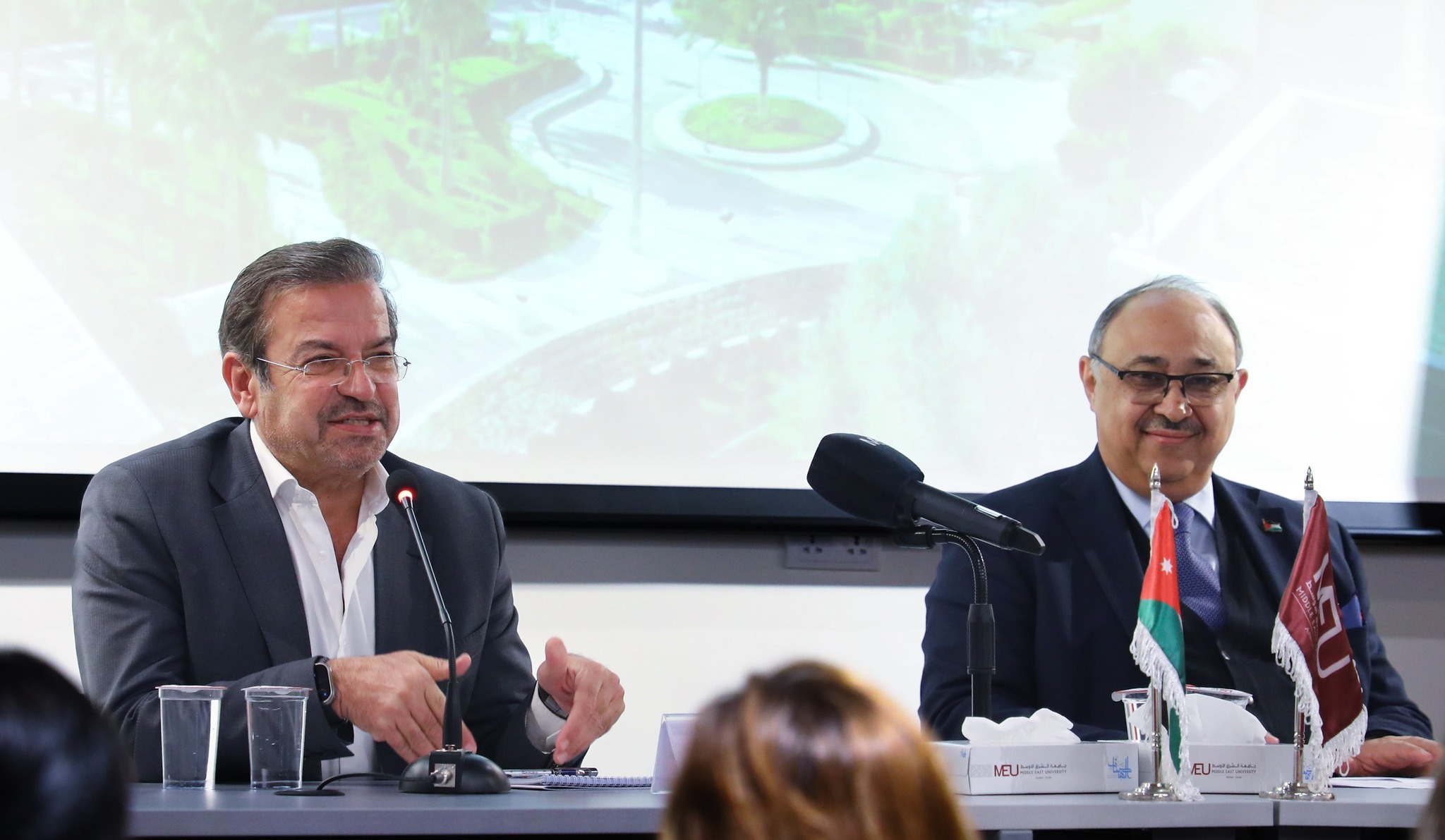
The Middle East University’s Faculty of Media recently hosted a high-level panel discussion featuring the former minister of information, His Excellency Dr. Sakher Doudin. The event was attended by the Chairman of the Board of Trustees, Dr. Yacoub Nasereddin, alongside the Faculty’s Dean, Dr. Ramez Abu Hasira; MP Professor Tamara Nasereddin; and a broad assembly of faculty members and students.
Against this backdrop of academic and professional exchange, the session—moderated by the media figure, Professor Hani Al-Badri—focused on the mechanics of misinformation. Dr. Doudin posited that rumours thrive in environments characterised by a vacuum of clear, accessible information. He further noted that a lack of transparent data flow inevitably creates a fertile breeding ground for the proliferation of “fake news” and inaccuracies.
Building on this point, the former minister warned that the unchecked dissemination of inflammatory content represents one of the most hazardous practices in the modern media landscape. He cautioned the audience against being drawn into deliberate campaigns of disinformation designed to sow discord.
Crucially, however, Dr. Doudin emphasised that the solution lies in education rather than mere restriction. He underscored the vital importance of instilling critical thinking and media literacy skills in students. By equipping the next generation of journalists with the tools to verify sources, he argued, the industry can foster a professional class capable of handling viral content with the necessary rigour and responsibility.
In a significant intervention, the university’s Chairman of the Board of Trustees, Dr. Yacoub Nasereddin, expanded the scope of the debate to include the “strategic depth” of the state. He urged a rational approach to information consumption, stressing that verifying facts before sharing them is a matter of national interest.
Ultimately, Dr. Nasereddin called for a renewed reliance on official channels and credible sources, asserting that Jordan’s sovereignty and national security remain non-negotiable priorities. This sentiment served as a final reminder that, in the digital age, professional integrity is inseparable from national stability.