
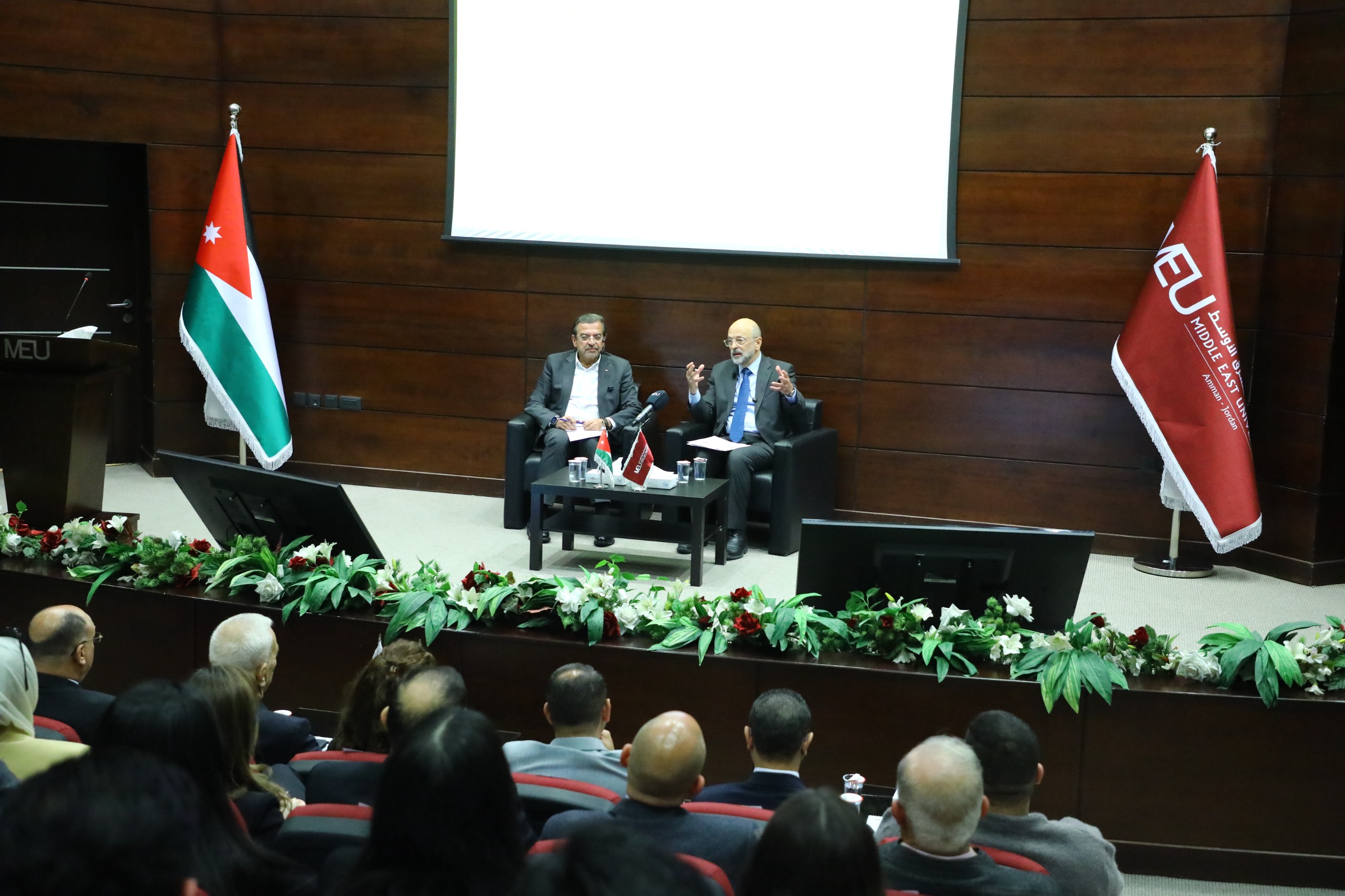
Former Prime Minister Dr. Omar Al-Razzaz affirmed the importance of listening to the experiences and ambitions of young people and working to frame them within the context of public work. Furthermore, he stressed that the absence of effective communication hinders the achievement of objectives, while dialogue constitutes an essential means for reaching a common understanding of challenges, solutions, alternatives, and scenarios.
This was witnessed during the “Middle East” Dialogues under the title “Public Work… Challenges and Responsibility towards the Role of Youth in Shaping the Future and Serving the Homeland”. The event was held in the presence of the Chairman of the Board of Trustees, Dr. Yacoub Nasereddin; the University President, Professor Salam Al-Mahadin; the Dean of the Faculty of Media, Dr. Ramez Abu Hasira; the Dean of Student Affairs, Dr. Hazem Al-Nsour; as well as a number of faculty deans, academic and administrative staff, and students.
In this context, Dr. Al-Razzaz pointed out that the world is living in a state of “lack of certainty” and that claiming to possess a clear vision of the course of events in the region and the world is unrealistic in light of rapid transformations. Consequently, he noted that the primary challenge lies in how to protect Jordan from the state of global turbulence and maintain its stability.
Moreover, he drew attention to the fact that the crises witnessed by the world today are not new, but they are manifesting in the context of the disintegration of international norms and the decline in the effectiveness of laws governing relations between states, which places the world in a state of ambiguity. Nonetheless, he emphasised the steadfastness of the Jordanian position and the clarity of its red lines.
Additionally, Dr. Al-Razzaz explained that the global system is witnessing a shift from unipolarity to multipolarity, which requires strengthening the Jordanian internal front and building a resilient society capable of facing challenges. In light of all of this, he stressed the importance of involving youth at this stage.
Similarly, he noted that the future of youth is directly linked to job opportunities, considering this file to be the biggest challenge for Jordan, especially in light of limited resources and increasing competencies. Therefore, he argued that this calls for the adoption of economic policies capable of generating sustainable opportunities.
Beyond economic factors, Dr. Al-Razzaz touched upon the impact of social media platforms and their repercussions on the social structure and the way youth view themselves, stressing the need to rebuild the educational process in a manner that is consistent with the requirements of the current stage.
Regarding the internal policy, he indicated that the legal system in Jordan has witnessed development that has enabled youth to exercise their roles, despite the existence of some constraints, which requires further work to expand the space for participation.
Concluding his dialogue with the university students, Dr. Al-Razzaz called on the youth to exercise their role effectively and to exert positive pressure toward national issues in a way that contributes to building a more stable future capable of facing challenges.