

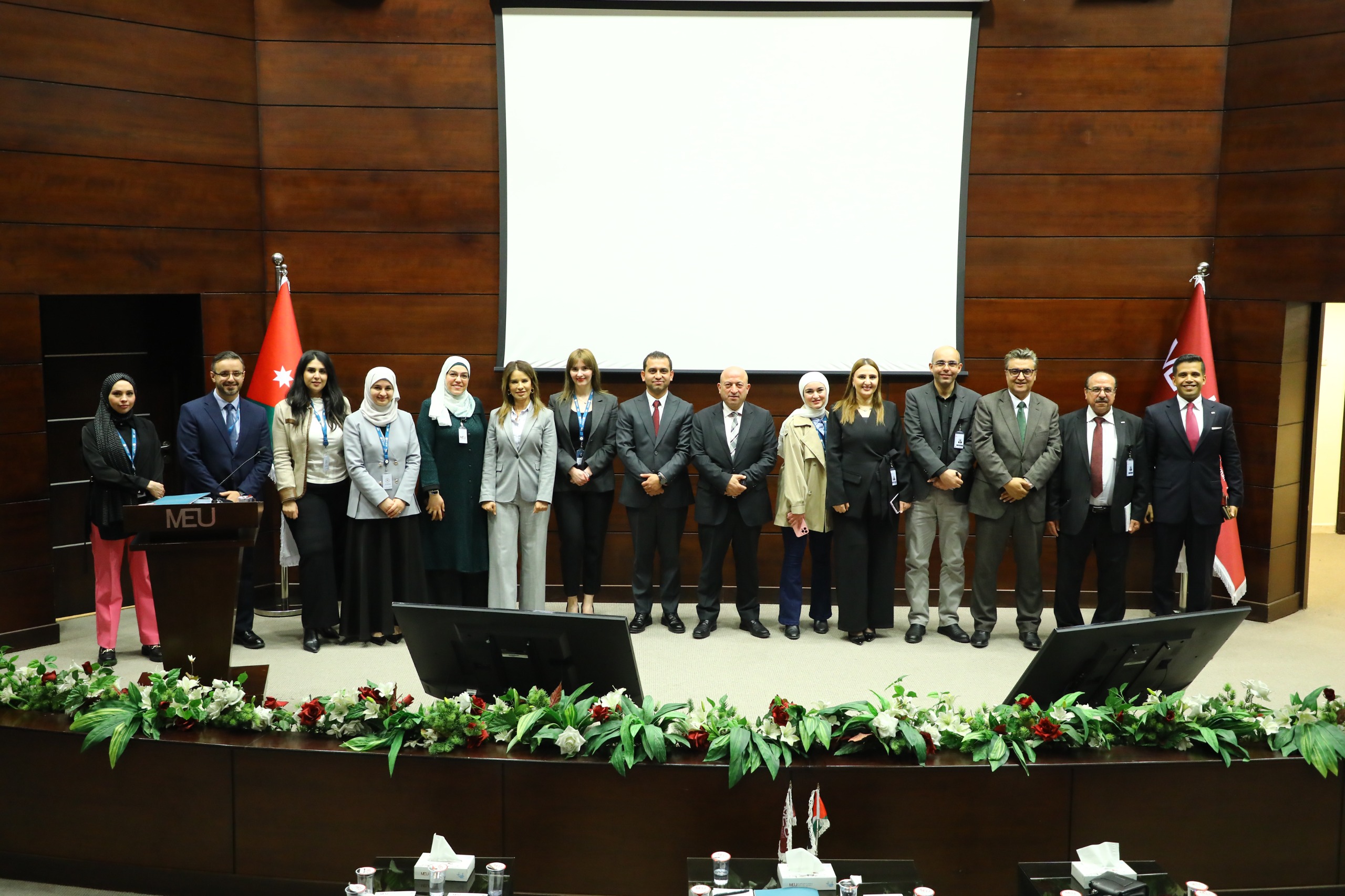
The Faculty of Business recently hosted a high-level delegation from the Central Bank of Jordan for a lecture entitled ‘Towards a Financially Literate Society’. Delivered by Dr. Adnan Saad, Assistant Executive Director of the CBJ, the session featured contributions from the Financial Consumer Protection Department and the National Payments System Supervision Department. The event, held to mark the Arab Financial Inclusion Day, was attended by the Dean of the Faculty of Business, Dr. Rania Al-Zaa’mat, and organised by Dr. Enas Al-Aboud, alongside academic staff and a large assembly of students.
Addressing the core pillars of national monetary policy, Dr. Saad emphasised that the Central Bank’s primary mandates include maintaining monetary stability and ensuring the continued convertibility of the Jordanian Dinar. He noted that these objectives are met by stabilising general price levels and maintaining a fixed exchange rate against the US dollar. Such measures, he explained, foster confidence in the national currency and attract foreign investment—a strategy reflected in Jordan’s robust reserves of foreign currency and gold, which reached approximately $28 billion by the end of February 2026. This reserve is currently sufficient to cover ten months of the Kingdom’s imports of goods and services.
Building on the theme of empowerment, Dr. Saad highlighted the critical importance of fostering financial literacy across all societal groups. He urged citizens to familiarise themselves with their rights when dealing with the financial and banking sectors, specifically the right to transparency regarding financial products. Furthermore, he detailed the established procedures for lodging and resolving formal complaints without delay across all banks and non-banking financial institutions operating in the Kingdom.
In tandem with these protections, the assistant executive director reaffirmed the Central Bank’s fundamental role in safeguarding the rights of financial sector clients. He clarified that any citizen may escalate a complaint directly to the CBJ should a financial institution fail to provide an adequate response, thereby ensuring fairness and the rigorous protection of consumer interests within the wider financial framework.
Expanding the scope of the discussion, Dr. Saad explored contemporary concepts such as sustainable finance and the transition towards electronic payments. He outlined the primary benefits of digital transactions—namely speed, convenience, and security—while also providing vital guidance on identifying and preventing financial fraud.
Reflecting the interactive nature of the briefing, the session concluded with an evaluative assessment for students based on the educational materials presented. Successful participants were awarded prizes provided by several leading institutions, including Jordan Islamic Bank, Arab Islamic International Bank, BLOM Bank, Cairo Amman Bank, Arab Bank, Safwa Islamic Bank, Middle East Payment Services (MEPS), and UWallet. These awards were distributed in the form of pre-funded bank accounts and promotional gifts, marking a practical step towards enhancing the students’ financial integration.